Avery Architectural & Fine Arts Library Acquires the John H. Yardley Collection of Architectural Letterheads
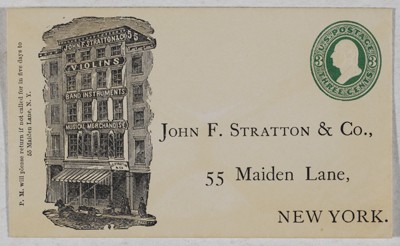
Assembled over many years, the Yardley Collection reflects a sensitivity to New York's geographic and architectural heritage. Most of the letterheads are organized by street, which allows readers to chart a path through the city, one address at a time. The section devoted to Maiden Lane, for example, has illustrations of a dozen commercial buildings that once lined this street in downtown Manhattan. Many of these buildings, like the musical instrument company of John F. Stratton at 55 Maiden Lane, are no longer standing. Another especially rich section of the collection focuses on hotels, with letterheads from as early as 1831.
Yardley began his collection in earnest in the late 1980's. Yardley and Gordon, spent weekends traveling to trade shows and collector meet-ups seeking out ephemera that highlighted the unique architecture of lower Manhattan, which Yardley had called home ever since arriving in New York. As his friends recount, he was truly enamored of lower Manhattan, with its winding streets and distinctive buildings reminiscent of his native London. At home, Gordon recalls, he could pour over a single piece of paper for hours looking for the secrets it revealed about the history of New York and the buildings people hustled by every day, but often never truly stopped to appreciate.
"I wanted to make this donation because the thing that John truly loved most about collecting was being able to share it with others," said Gordon. "He wanted to share his passion and fascination with the oldest parts of New York and it makes me happy that I can honor him now by sharing this collection with the public."
Images of those distinctive buildings are now preserved in the Yardley Collection, which joins the Avery Library's other strong holdings in architectural ephemera. These holdings reflect Avery's commitment to preserving ephemera as an essential and irreplaceable visual record of the historic built environment.