Donating Materials
The University Archives welcomes donations of university records of enduring historical value and Columbia-related materials - including university publications and ephemera – regardless of format.
- If you are a current or former student who has personal or student group materials you would like considered for the University Archives collections, please see our guidelines for donating Student Life materials and then contact uarchives@columbia.edu with specific details about your possible donation.
- If you work in a University office or department and want those office/department files to come to the University Archives for permanent retention, please contact uarchives@columbia.edu to arrange for a site visit to survey your records and make decisions about what should be transferred to the Archives. Please consult our guidelines for Managing University Records for more information on records retention and disposition.
- If you are a non-Columbia affiliated individual with Columbia-related materials for possible donation, please email uarchives@columbia.edu and provide specific details about your materials so our staff can fully consider your offer.
For all internal transfers of Columbia University records or materials, the donor should complete and return the Records Transmittal Form prior to physically transferring any files to the University Archives. Arrangements for transfers of records must be made with University Archives staff before anything moves from your space to ours.
To prepare your materials for donation, please read our recommendations on how to pack boxes and how to transfer digital records.
The University Archives reserves the right to de-accession files if they are obsolete, superseded, duplicated elsewhere, or otherwise irrelevant to the collection. For more information, see our Collection Development Policy. De-accessioned material will be discarded or redistributed to a more appropriate repository by University Archives staff unless the donor specifically requests the return of any unwanted material at the time of transfer/donation.
The University Archives also seeks to educate the Columbia community regarding the existence and importance of historical records in the University’s offices and to encourage the transfer of historical records to the Archives. In its commitment to the University’s overall mission of teaching and learning, the Archives informs the Columbia community and the community of scholars about the wealth and value of its holdings and encourages their use.
In consultation with RBML Curators, the University Archives encourages senior faculty members and administrators notable either by their outstanding contributions to their fields or by particularly distinguished service to the University to deposit their personal papers in the appropriate repository. Faculty papers, regardless of format, document the individual’s career at the University and their research discoveries or projects. Of particular interest are materials related to teaching, research and service work conducted by the faculty member during their time at Columbia. These include:
- Autobiographical materials: CVs, bibliographies, oral histories, interviews; photographs, negatives and slides, photo albums (all preferably labeled); personal memoirs, diaries or journals
- Course materials: syllabi, course outlines, lecture notes, handouts, exams and assignments, reading lists, and other classroom materials; course proposals
- Research-related files: grant applications, proposals and final reports; unpublished papers; publishers’ contracts, comments and galley proofs; patent applications; drafts of nonfiction, only if they have significant and substantial annotations, are seminal works or the author received an award for the publication
- Scholarship: Talks, lectures, conference presentations
- Administrative materials: documents related to the faculty member’s service at the University such as information on new programs and initiatives, memos and notices about departmental policy, agendas, meeting minutes, reports, resolutions from faculty committees and departmental meetings
Limited interest:
- Books, articles and book reviews published by the faculty member or in honor of the faculty member: we collect only those that are currently not part of the Columbia Libraries collection. However, we would consider duplicate copies if they include annotations.
- Research notes, lab and field notebooks, analyses and reports of findings, manuscripts, research data.
- Newspaper clippings, press releases, transparencies, models, scrapbooks, calendars and memorabilia
Outside of our collecting policy:
- Personal libraries, reprints and offprints, books and magazines, unannotated photocopies of book chapters and articles
- Professional correspondence related to specific individuals: letters of recommendations, tenure review assessments for both internal and external candidates, performance evaluations
- Grades and evaluations of students; grade reports, graded assignments, exams or papers; course evaluations
- Search, recruitment, promotion and other personnel-related records
- Professional organization memberships, renewals, conference agendas and proceedings, and other attendance and travel related materials such as logistics and meeting arrangement records
- Medical and legal records
- Financial records: invoices, receipts, tax returns, pay stubs, bank statements, cancelled checks, royalty statements
- Policy and procedure manuals; handbooks; equipment maintenance records
- Three-dimensional items: such as busts, plaques, trophies.
- Honors, prizes, awards, diplomas, certificates, honorary degrees
- Duplicates, blank forms, stationery, letterhead
- Typewriters, word processors, and computer equipment: We are interested in the faculty member’s electronic files, but not necessarily the technology used to create and/or preserve the works.
The University Archives welcomes donations of Columbia-related materials from students, student organizations, alumni and friends of Columbia University. We are interested in materials, both paper-based and digital, which document campus and student life such as:
- Course materials, including notes, syllabi and assignments
- Event posters, flyers, programs, tickets, scripts and scores
- Journals, diaries, scrapbooks, letters
- Photographs (preferably labeled)
- Student group charters, by-laws, annual reports, minutes, membership lists, organizational histories
- Publications, newsletters, brochures, booklets, websites
- Other ephemera such medals, pins, banners, and commemorative items
If you have Columbia-related materials you wish to give to the University Archives, please contact uarchives@columbia.edu and provide us with as much detail as possible about the material you wish to donate.
Whether or not you choose to donate your organization’s records to the University Archives, we offer guidance to student organizations in developing their recordkeeping practices to preserve their group's history. Because students spend a limited amount of time on campus, we hope to share some solutions for how to maintain your organization's history in a way that can be passed down to future members. Check out the Records Management for Student Organizations guide to learn how to sort significant records from those that can be safely discarded and learn some best practices for storing, organizing and making records accessible.
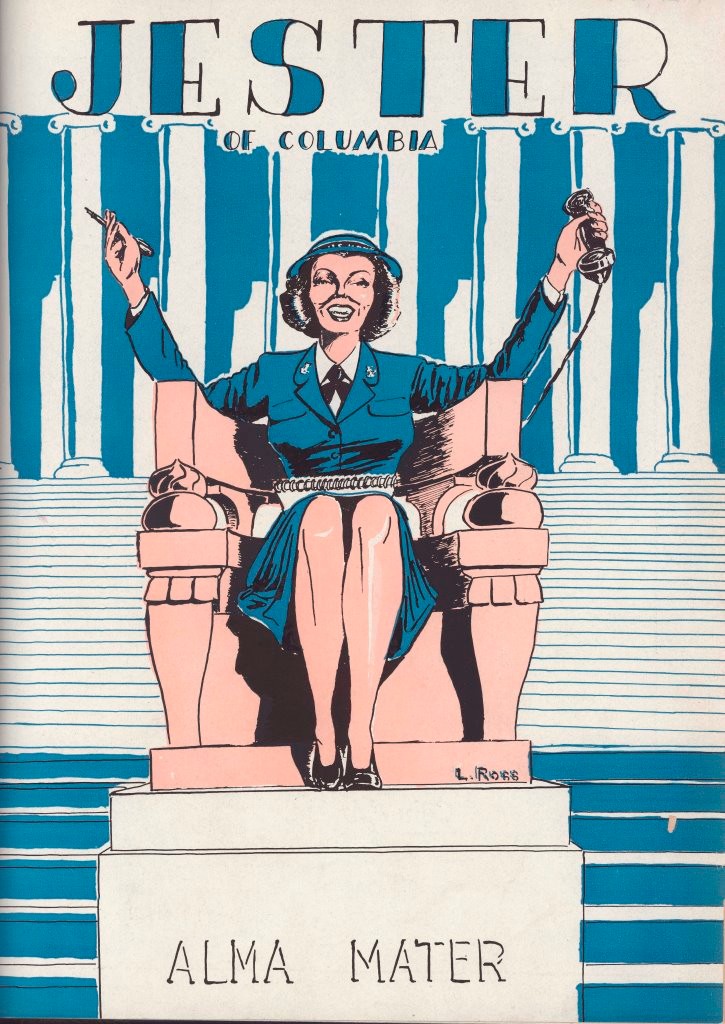 The Columbia Jester cover, 1945
- The Columbia Spectator Digital Archive includes a mostly complete run of the student newspaper from 1877 to 2015. There are a few issues missing from our holdings. If you have any of these past issues, please contact uarchives@columbia.edu.
- The University Archives has an almost complete run of The Columbia Jester, the humor magazine. Volume numbering for this publication is inconsistent and the number of issues per year also varies. If you have any issues that a missing from our holdings, please contact uarchives@columbia.edu.
- The University Archives also has a complete run of Columbia College yearbooks and a mostly complete run of the School of Engineering yearbooks. Some of our copies may not be in the best condition so we are seeking second copies for a select number of years. If you have one of these yearbooks you would like to donate, please contact uarchives@columbia.edu.
- Columbia traditions, such as the Varsity Show, are well represented in our holdings and related items are always welcome. We are also interested in materials related to Orientation, Homecoming, Commencement and Reunion.
- Finally, we are interested in materials related to student protests and activism, which are an integral part of campus life, from the occupation of five buildings in April 1968 to the present.