About the Roll of Honor

The Columbia University Roll of Honor has been online since 2008. The University’s archival records served as the primary resource for creating the Roll of Honor website. Information varies in depth and detail, and data are incomplete even for those wars about which the archives has the most information. This site is updated quarterly, subject to the availability of resources and the volume of additional, verifiable information to be added.
Submit Additional Information
Please contact us at uarchives@columbia.edu:
- if any of our information is incorrect.
- if you have confirmed documentation, additional photos, and/or tributes about someone already on the list or about another member of the Columbia community who was killed in one of the United States's military conflicts.
- if you are aware of a Columbia student or alumnus who died in military service for their country and are not currently included in this site.
Creating the Roll of Honor
Columbia Provost Alan Brinkley convened a Working Group on War Remembrance in 2007 to plan a memorial to recognize those students and alumni who died in the service of the United States, building on the earlier efforts of a group of alumni. The Working Group, which included faculty, students, administrators, and alumni, concluded that any monument to Columbia’s war casualties will always be a work in progress.
The Roll of Honor memorial website acknowledges the sacrifice of each as an individual.
A plaque, installed in Butler Library, recognizes the contributions of these Columbians as a group. Take a War Memorial Campus Tour.
Roll of Honor Website
The current Columbia University Roll of Honor, created in 2021, is the second edition of the Roll of Honor website and is now part of Columbia University Libraries.
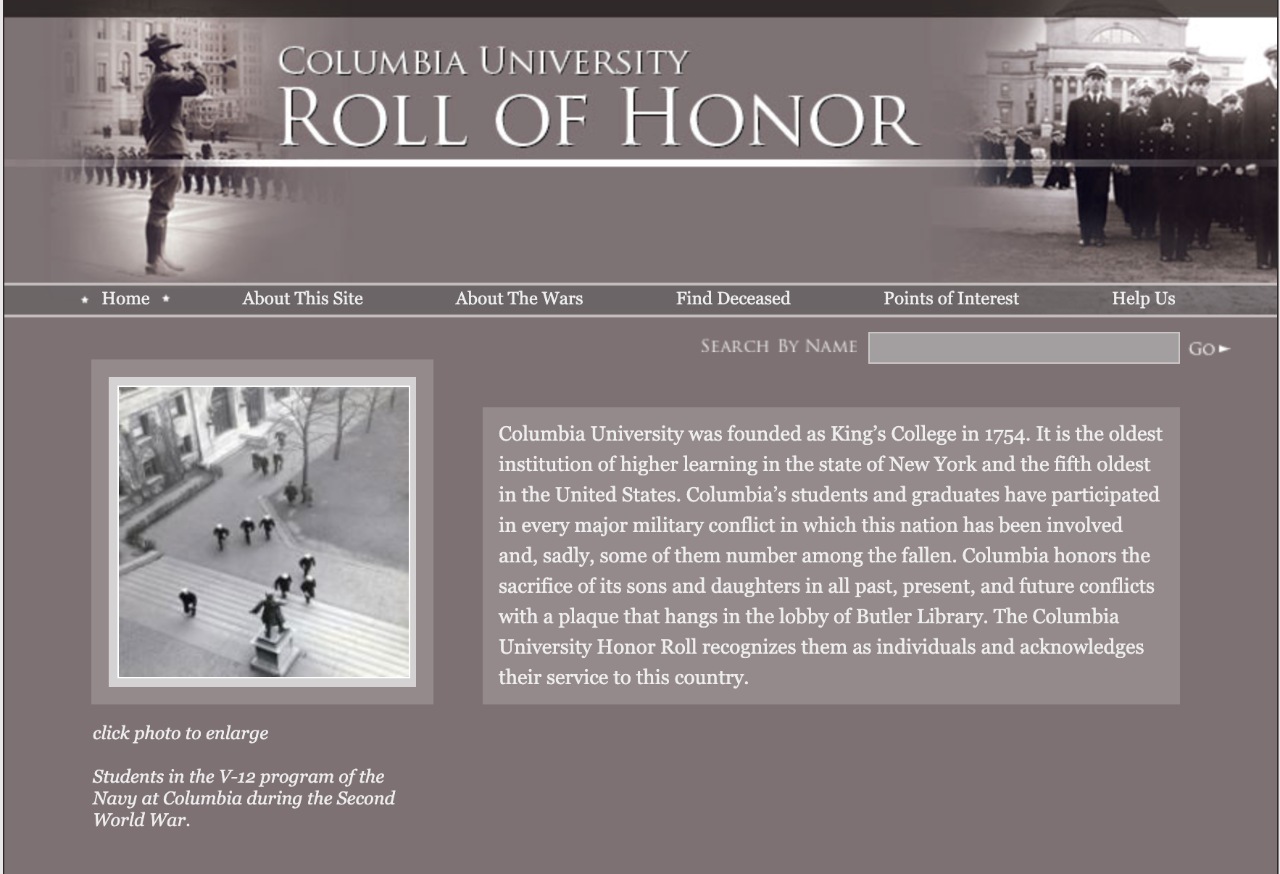
Text related to the wars and the information about the fallen alumni and their phototgraphs were faithfully brought over from the original website. However, the original included photo slideshows to provide contextual information about the different conflicts, featuring artistic depictions and photographs from the Library of Congress, National Archives and other sources. In the second edition, the contextual images are now more locally focused, including only depictions of the Columbia buildings and grounds at the time of the conflict and photos of the military presence on campus.